When Your Commercial Vehicle Can't Move
Commercial Vehicle Recovery in Evansville for semis, box trucks, and vehicles disabled by damage or position
A semi jackknifed on an off-ramp or a loaded box truck stuck in soft ground requires more than a standard tow hookup. Feller Towing & Recovery INC handles commercial vehicle recovery in Evansville, working with commercial drivers and fleet operators when positioning, damage, or the nature of the incident makes moving the vehicle a planning challenge rather than a routine call.
Recovery differs from towing when the vehicle cannot be safely hooked and moved in one direct operation. The process begins with evaluating the scene, vehicle orientation, load distribution, and surrounding obstacles before selecting rigging, winching, or repositioning methods that protect both the vehicle and the roadway. Variables such as weight distribution in a loaded trailer, the angle of the vehicle relative to the shoulder, and clearance around axles all influence which approach minimizes further damage.
Request an on-site evaluation by sharing incident location and vehicle details when you call.
What Recovery Involves Beyond a Hookup
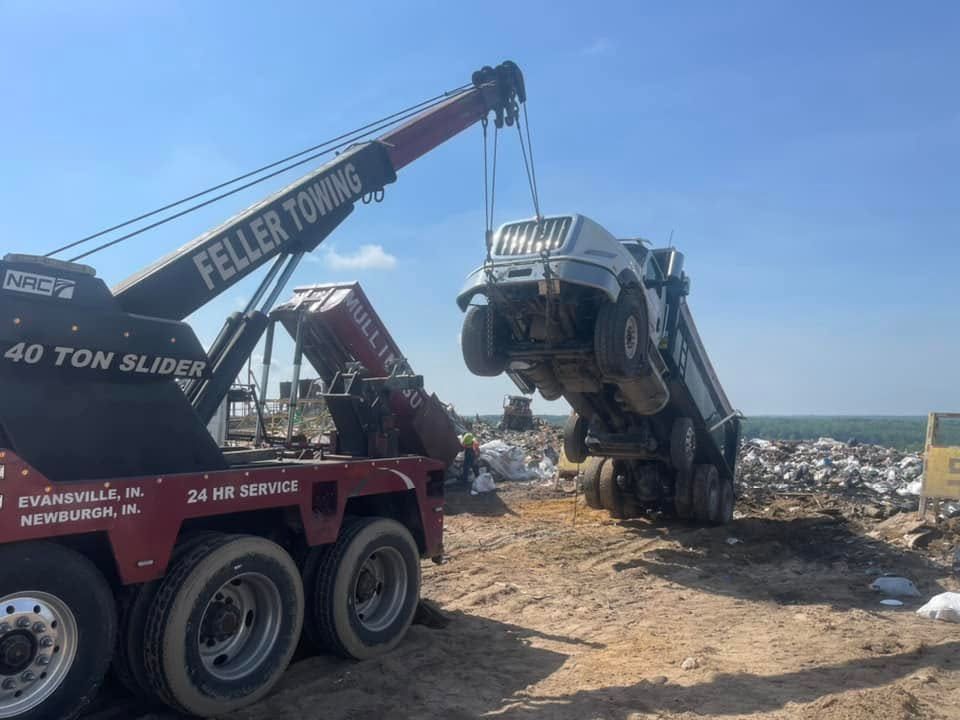
Commercial vehicle recovery often starts with stabilization before any movement occurs. If the vehicle is tilted, the load must be assessed for shifting that could worsen the angle during extraction. Winching may reposition the vehicle onto stable ground before tow equipment can be attached, and wheel dollies or air cushions may be introduced when conventional towing points are obstructed or compromised by collision damage.
Once the vehicle reaches a transportable position, you notice secure attachment at multiple points rather than a single hitch connection, especially when suspension or frame components are damaged. The recovery ends with the vehicle relocated to a repair facility, fleet yard, or secure lot, cleared from the roadway and positioned for inspection or parts removal without additional handling.
Recovery capability also ties into roadside service when the issue is mechanical rather than positional. Feller Towing & Recovery INC coordinates towing, recovery, and roadside response based on what the situation requires, allowing commercial operators to describe the incident and receive the appropriate dispatch rather than guessing which service to request.
What Commercial Drivers Should Know
Fleet operators and drivers calling from the roadside often need clarity on what recovery entails and how the service unfolds after the initial call.
What counts as a recovery instead of a standard tow?
Recovery applies when the vehicle is in a position, condition, or location that prevents standard tow hookup. Examples include semis off-road in soft soil, vehicles tilted beyond safe towing angles, and trucks with undercarriage damage blocking normal attachment points.
How long does a commercial recovery typically take?
Time depends on vehicle size, positioning difficulty, and site access. A box truck nosed into a ditch may take thirty minutes to winch onto pavement, while a semi requiring load stabilization and multi-point rigging can extend beyond two hours.
What should I have ready when calling for recovery in Evansville?
Provide vehicle type, approximate weight or load status, your exact location with nearest cross street or mile marker, and a description of how the vehicle is positioned. Photos sent during the call help dispatch select the correct equipment before arrival.
Can recovery handle vehicles with load still attached?
Yes, though the load's weight and distribution affect how the vehicle is stabilized and moved. If the load has shifted or the trailer is compromised, the process may include securing or redistributing weight before extraction begins.
Does Feller Towing cover areas outside Evansville for commercial recovery?
Service extends throughout surrounding areas where commercial routes and industrial corridors operate. Drivers should call with location details to confirm coverage and estimated response time.
Feller Towing & Recovery INC coordinates recovery, towing, and roadside assistance from a single call, matching the response to the incident rather than requiring drivers to diagnose service type from the shoulder. Call (812) 471-1177 with vehicle and location details to begin dispatch.